
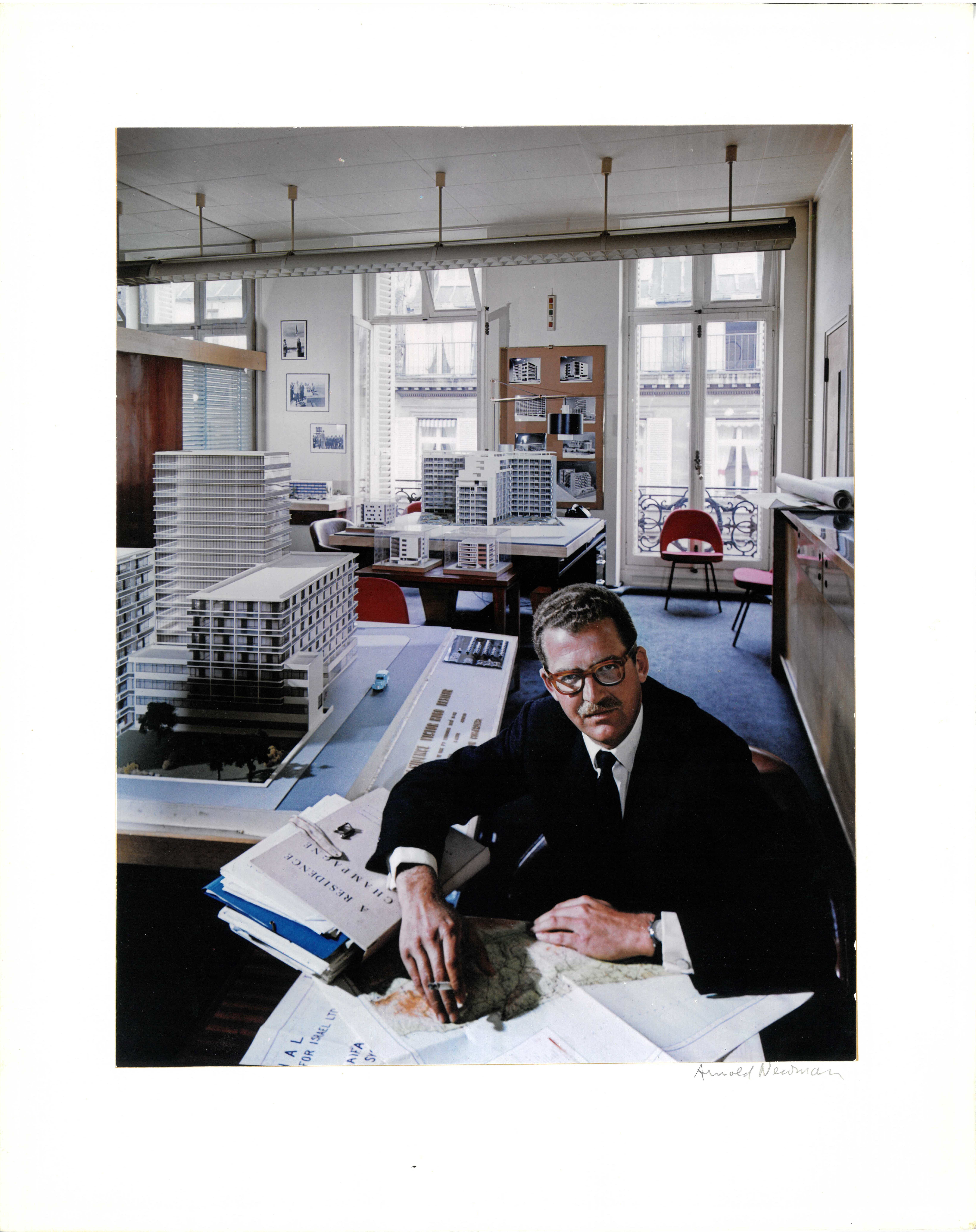
Born in Paris on 30 September 1926, Edmond de Rothschild would have turned 100 this year. Beyond the fortune and the family name was a driven man, shaped by the war, who devoted his life to building the firm that now bears his name.
He would laugh at first. But then, if you continued to disagree, he would set about persuading you. In 1979, journalist Gérard Moatti encountered a 52-year-old banker with bright eyes and an easy smile, whose affable demeanour should not be taken at face value. Edmond de Rothschild was a swift decision-maker, comfortable with risk and capable of being uncompromising in business. He made little attempt to preserve the formality traditionally associated with his name. By then, his Group extended from Paris to Geneva, and from San Francisco to Hong Kong. He travelled across it as an attentive owner, driven by the urgency and restless energy of a founder.
To understand this restlessness, one must go back to 1940. Edmond was the only son of Maurice de Rothschild and Noémie Halphen, who divorced when he was still a child. Raised by his mother, he grew up in the French upper-middle-class milieu of the pre-war years, spending his summers in Houlgate and his winters in Megève. His maternal grandfather, a military officer, shared stories of Verdun and the Chemin des Dames. Edmond felt unequivocally French, never imagining that this sense of belonging could one day be denied him.
Defeat brought his childhood to an abrupt end. Maurice de Rothschild, a member of parliament and a friend of Georges Mandel, had voted against granting full powers to Pétain. The Vichy regime subsequently stripped both father and son of their French nationality. Edmond left Megève for Geneva with his mother. They lived modestly in a cottage on the family estate, supported by an allowance from England. He pursued his studies without much enthusiasm before joining the Army of the Alps, too young, and too late, to play any meaningful part in the conflict. He would never lend this episode a significance it did not deserve. Instead, he drew from it a more personal lesson: “The war had shown me that nothing is eternal, that nothing is absolute. I arrived in Paris in 1946 with a great thirst for life and, above all, to forge a new identity for myself.”1
His father, too, had changed. Before the war, Edmond had seen little of him. Deeply involved in French political life, Maurice collected works of art, racehorses and travels, far more than he did business. Sent to Canada and Nassau during the war before settling in the United States, Maurice developed a late interest in business. Between 1943 and 1955, he amassed a considerable fortune. From this, Edmond drew one enduring conviction: no wealth is ever entirely secure.
Back in Paris, he set about learning the ropes. He worked in import-export alongside his cousins and travelled to Brazil, Argentina and the United States. In 1953, drawing on his own capital, the backing of his cousin François Pereire and the support of Albin Chalandon, he founded the Compagnie Financière. Four years later, Maurice’s death left him at the head of a considerable fortune. He never claimed to have started from scratch. In his own eyes, his achievement lay in what he made of the capital he had inherited: “I was an enterprising young man. I was not interested in simply cashing in my coupons and hunting for antiques. I wanted to play my part in modern liberal society, using the resources at my disposal.”2
France during the Trente Glorieuses provided the ideal backdrop for his ambitions. He placed less faith in heavy industry than in services, tourism, housing and the media, sectors that benefited directly from rising living standards. Through Cogifrance, he played a role in the property boom. In Megève, he further developed the resort founded by his mother. He supported Club Méditerranée, initially because he admired Gérard Blitz and Gilbert Trigano, but also because he recognised the strength of their concept. He expanded into the toy, press and paper industries, while wine was soon to assume a special place in his portfolio. Abroad, he invested in banking, transport and energy. The breadth of his activities defies easy categorisation, yet one maxim recurs throughout his remarks: “I would rather be a major player in a small industry than a minor player in a large one.”3
He was no theorist. He observed a market, met a person and then made up his mind. This approach brought both major successes and costly mistakes. Inno-France, his attempt to enter the discount retail sector, proved expensive. He made no excuses: “Large-scale retail is not a business one can improvise. I have never ventured into it again.”4 He also misjudged the launch of the weekly magazine Continent, modelled on Time. Later, he spoke of these setbacks without embarrassment. He had learned that intuition could never replace a thorough understanding of a business.
By the mid-1980s, inflation and the more uncertain-than-expected returns on certain investments were no longer shielding the conglomerates from their weaknesses. Edmond de Rothschild sold his stake in the Bank of California to Mitsubishi, streamlined his Group and refocused it on banking. The phrase was almost bureaucratic, and therefore perfectly chosen: “On my passport, I have stopped describing myself as a company director; I have become a banker.”5 The Compagnie Financière expanded into advisory services, market operations and wealth management. In Geneva, the Banque Privée, of which he acquired a stake in 1965 before taking full control in 1971, became his other mainstay. His international ambitions remained intact but assumed a more disciplined form. He understood that commercial banking remains closely tied to its home market, whereas wealth management and investment banking can connect Paris, Geneva, Luxembourg and London.
His leadership style stood in stark contrast to the image of the immovable banker. He travelled constantly, made calls from his yachts, and moved seamlessly from financial meetings to visits to vineyards. He delegated extensively to the people he had chosen, while keeping a close eye on budgets, testing ideas and scrutinising the details. His colleagues discovered that beneath his affable manner was a decisive, at times demanding, but deeply loyal leader. He was wary of overly cumbersome management structures and large meetings designed to rally executives. “I have no desire to play the part of the big boss: it is a form of ego-boosting that holds no interest for me.”6 The remark reflects his aversion to posturing. Edmond de Rothschild preferred to remain close to the business rather than preside over an organisational chart.
Within the bank, too, he rejected posturing and conventional models. The Compagnie Financière sought neither an extensive branch network nor a large balance sheet. Internally, this ambition was captured in a simple phrase: “small bank, big ideas”. Edmond de Rothschild focused on advisory services, wealth management, capital markets and corporate services. From the early 1980s onwards, the bank offered innovative SICAVs and mutual funds, served major institutional investors and developed recognised expertise in cash management. Asked about the bank’s growth, he replied that it would be driven by “modern, even futuristic” services, not by a branch network. In doing so, he turned a significant constraint into a guiding principle.7
This avant-garde approach served very practical purposes. The Trésor series brought information technology to corporate finance departments, giving them access to money-market and stock-market data. In 1984, the bank launched Bancovox: a compact telephone-connected terminal that enabled users to make remote transfers and check the dollar exchange rate. At the time, Le Nouvel Économiste described it as unique in the world. The product may now seem dated, but the vision endures: a bank must equip its clients to understand, decide and act without delay. Long before mobile banking, Edmond de Rothschild had recognised this potential.8
The bank looked towards emerging sources of growth. As early as the late 1970s, it drew on the Bank of California to keep abreast of new electronics companies; a few years later, it launched two SICAVs dedicated to high technology. It also extended its presence in the Pacific region through Pacifique-Saint-Honoré, Hong Kong and Australia. In 1982, the Compagnie Financière was even the Bank of China’s smallest correspondent bank. Edmond did not simply accumulate branches. He sought expertise, market access and ideas that Paris alone could not provide. The bank was modest in size, but not in scope.9
In 1983, a survey of finance directors described the bank as “the most attractive”, “more agile than a large bank, more sophisticated than a small one”. The description might equally have served as a portrait of Edmond himself. His capital allowed him to make decisions quickly; his preference for specialists led him to recruit technically skilled people and give them room to act. He rejected the pursuit of scale, directing the bank towards areas in which expertise mattered more than the size of its balance sheet. He did not seek to build the largest institution. He sought to create a place where an idea could become a business. This was the mark he would leave on the firm that now bears his first name.10
As the years passed, succession became increasingly important. Edmond had long been preparing Benjamin for the future, without offering him an easy path. As a teenager, his son studied in Switzerland, where he lived alongside young people from Europe, Africa and the Americas. Later, his father sent him to work in struggling businesses rather than prosperous banks. He wanted to free Benjamin from the assumption that success came easily and to teach him an appreciation of the challenges of running a business. In 1985, Edmond explained: “My aim is not merely to pass successful businesses on to my son, but also to ensure that he can play an effective role in running them.”11
In 1993, the succession process began. Benjamin started out in management and derivatives, while his father allowed him time to find his footing. Edmond himself returned to Château Clarke, in Listrac-Médoc, an estate he had acquired in 1973. Already a shareholder in Château Lafite Rothschild, he wanted an estate of his own in which to put his personal vision of winemaking into practice. It was a radical undertaking. He had the entire vineyard uprooted and replanted, choosing Merlot, which was better suited to the cold clay-limestone soils than Cabernet Sauvignon, then the dominant variety in the Médoc. The first vintage was not released until 1978. He also revived Merle Blanc, a former speciality of the estate, in an appellation dominated by red wine. This acquisition marked the beginning of a winemaking adventure that the family would pursue long after him, far beyond the Bordeaux region.12 Wine forced the man in a hurry to come to terms with the long term. Yet, as in his other ventures, he invested on the basis of his own judgement and waited for his wager to be vindicated. As he later remarked, with characteristic humour: “Having noticed that vines improve with age and that good wine matures over time, I rather like the comparison as I grow older myself.”13
Edmond de Rothschild died in Geneva on 2 November 1997. He left Benjamin and his wife, Ariane, an international organisation, dedicated teams and a distinctive view of capital: a means to an end. The Rothschild name had given him everything, but it had also imposed certain constraints. By adding his first name, he had charted a course of his own.
A journalist once asked whether he had rebuilt his fortune, as his father had done. His answer comprised just five words: “No. I did something else.”14 That “something else” still bears his name.
1. Gérard Moatti, ‘I remain an SME… Playing the part of a big boss is a way of satisfying one’s ego which holds no interest for me’, interview with Edmond de Rothschild, L’Expansion, June 1979, p. 205.
2. Ibid., p. 207.
3. Ibid., p. 209.
4. Ibid., p. 207.
5. Claude Villeneuve, ‘The baron discovers austerity’, interview with Edmond de Rothschild, Le Nouvel Économiste, 18 January 1985, p. 43.
6. Gérard Moatti, interview cited above, L’Expansion, June 1979, p. 211.
7. Jean Boissonnat, ‘A Rothschild in Socialist France’, interview with Edmond de Rothschild, L’Expansion, 4–17 June 1982, pp. 93–94.
8. Claude Villeneuve, ‘The Rothschild 85’, Le Nouvel Économiste, 18 January 1985, p. 45.
9. Gérard Moatti, interview cited above, L’Expansion, June 1979, pp. 209–211; Jean Boissonnat, interview cited above, L’Expansion, 4–17 June 1982, p. 95; Claude Villeneuve, article cited above, Le Nouvel Économiste, 18 January 1985, p. 45.
10. Claude Villeneuve, ‘Le Rothschild 85’, Le Nouvel Économiste, 18 January 1985, pp. 40 and 44–45.
11. Claude Villeneuve, interview cited, Le Nouvel Économiste, 18 January 1985, p. 43.
12. Sylvain Ouchikh, ‘The audacity of Edmond de Rothschild’, Les Echos Série Limitée, p. 50.
13. Nazanine Ravai, Philippe Mudry and Yves Messarovitch, ‘Edmond de Rothschild, an independent banker’, Le Figaro L’Aurore, 15 November 1994, p. VII.
14. Gérard Moatti, interview cited above, L’Expansion, June 1979, p. 213.